
UploadBlog.com Content Marketing: Practical Strategies for Online Growth
UploadBlog.com content marketing applies this idea to publishing articles and other useful written material through UploadBlog.com or similar publishing environments. The important point is that publishing an article is not the same thing as having a content marketing strategy. A successful strategy starts with the audience. You need to know what people are searching for, what problems they are trying to solve, and what information would genuinely help them.
UploadBlog.com presents itself as a publishing platform where writers, businesses, and creators can publish online content. That makes it potentially useful as one distribution channel within a broader marketing plan. However, no publishing platform should be treated as a shortcut to guaranteed rankings, backlinks, leads, or sales. The quality of the content, relevance to the audience, technical SEO, promotion, and overall brand credibility still matter.
Read More: UploadBlog Login: Simple Steps to Sign In to Your Accoun
Why Use a Publishing Platform as Part of a Content Strategy?
Building Brand Visibility
Consistent publishing gives a brand more opportunities to communicate with its target audience. For example, a small software company could publish articles about productivity, software selection, common workflow problems, and practical technology tips. A marketing agency could create guides about SEO, social media, email marketing, and conversion optimization.
Over time, these useful topics can create a recognizable content footprint. The objective should not be to publish as much as possible. It should be to publish content that answers real questions and demonstrates genuine expertise.
Reaching New Audiences
Publishing outside your primary website can introduce your ideas to readers who may not have encountered your brand before. This can be particularly useful for freelancers, consultants, startups, and small businesses that are still building their online presence.
Still, distribution should be viewed as one part of a larger system. Your own website, email list, social channels, communities, and other relevant platforms can work together rather than relying on a single publishing site.
Creating a Consistent Publishing Habit
Content marketing becomes easier when publishing is treated as a process instead of a one-time campaign. A simple schedule might include one high-quality article every week or two. The exact frequency matters less than whether you can maintain the quality over time. Consistency also makes it easier to identify which subjects attract attention and which topics need improvement.
How to Build an UploadBlog.com Content Marketing Strategy
Define Your Target Audience
Start by identifying who you want to reach. Ask:
- Who are they?
- What problems do they have?
- What questions do they search for?
- What products or services might solve those problems?
- What type of information would make them trust your brand?
For example, an accounting firm targeting freelancers could create content around tax preparation, expense tracking, invoices, cash flow, and financial organization.
Choose Topics Based on Search Intent
Keyword research is useful, but keywords alone are not enough. A phrase may have significant search volume while still being a poor fit for your business. Instead, consider the reason behind the search.
Someone searching “how to create a content calendar” probably wants instructions. Someone searching “content marketing agency” may be comparing services. Someone searching for a particular product may be close to making a purchasing decision.
Create Useful, Original Content
The strongest content answers a question clearly and provides something the reader can actually use. That might include:
- Step-by-step instructions
- Practical examples
- Checklists
- Comparisons
- Original observations
- Data supported by reliable sources
- Lessons from real experience
- Answers to common problems
Avoid rewriting existing articles with different wording. Originality is not simply about changing sentences. It is about adding genuine value, useful organization, experience, or perspective.
Optimize Each Article for Search
SEO should support the reader rather than interrupt the reading experience. Use the primary keyword naturally in appropriate locations such as the title, introduction, relevant headings, and body copy. Add related phrases where they make sense. You should also optimize:
- Page title
- Meta description
- URL
- Heading structure
- Image alt text
- Internal links
- Relevant external references
- Paragraph readability
Do not force the focus keyword into every paragraph. Excessive repetition can make an article sound artificial.
Add Relevant Calls to Action
A good content marketing article should have a logical next step. Depending on the purpose of the article, the call to action could invite readers to:
- Visit your website
- Read another guide
- Download a resource
- Request a consultation
- Join an email list
- Try a product
- Contact your business
The CTA should fit the reader’s stage in the buying journey. An informational article should not feel like an aggressive sales page.
Content Types That Work Well for Marketing.
| Content Type | Main Purpose | Example Topic | Best Use |
| Educational guide | Build trust | Content marketing basics | Awareness |
| How-to article | Solve a problem | How to create a content calendar | Search traffic |
| Industry commentary | Demonstrate expertise | Marketing trends for small businesses | Authority |
| Case study | Show results and process | How a business improved conversions | Consideration |
| Comparison article | Support decisions | SEO tools compared | Commercial intent |
Educational Guides
Educational articles are useful when your audience is unfamiliar with a subject. For example, a cybersecurity company could publish an introductory guide explaining phishing, password security, and account protection.
How-To Articles
How-to content is naturally useful because it addresses a specific task. A strong tutorial should tell readers what to do, in what order, and what mistakes to avoid. Whenever possible, use examples instead of vague advice.
Industry Commentary
Commentary can help establish expertise. Instead of repeating generic industry news, explain what a development means for your particular audience. That interpretation is where much of the value comes from.
Case Studies and Examples
Case studies provide evidence of how a strategy works in practice. A useful case study explains the situation, the problem, the approach, the obstacles, and the outcome. Be honest about limitations rather than presenting every campaign as a perfect success.
SEO Best Practices for UploadBlog Content

Use Keywords Naturally
Start with one primary search phrase and build the article around the reader’s needs. Then use closely related terminology naturally. Search engines are capable of understanding topics through context, so an article does not need to repeat one exact phrase dozens of times.
For this article, for example, relevant concepts include content strategy, search intent, organic traffic, content distribution, audience engagement, and SEO.
Improve Article Structure
Good structure helps both readers and search engines understand a page. Use one clear H1, logical H2 sections, and H3 headings where a subject needs additional organization. Keep paragraphs relatively short, especially for mobile readers. Lists can also make complex information easier to scan.
Strengthen Internal and External Relevance
If your article is part of a larger website, connect it to related pages using meaningful internal links. For example, a content marketing article could link to pages about SEO, keyword research, email marketing, and conversion optimization.
External links should point to reputable sources when they add context or evidence. Links should exist because they help readers, not simply because you want to manipulate rankings.
Prioritize Readability and User Experience
A technically optimized article can still fail if it is unpleasant to read. Use clear language, descriptive headings, useful examples, and natural transitions. Avoid excessive jargon. If a technical term is necessary, explain it in plain language. Readers should be able to scan the article and quickly understand whether it answers their question.
Common Content Marketing Mistakes to Avoid
Keyword Stuffing: Repeating “uploadblog.com content marketing” unnaturally throughout an article does not make the content better. Use the focus keyword where it makes sense and rely on related language to develop the topic.
Excessive Self-Promotion: An article that talks about a business in every paragraph quickly loses credibility. Teach first and promote second. A reader should finish the article feeling that they received useful information, even if they never become a customer.
Publishing Thin Content: A short article is not automatically bad, but content that says very little will rarely provide much value.
Before publishing, ask whether the article genuinely answers the reader’s question better than a basic definition would.
Chasing Links Instead of Value: Backlinks can be useful, but pursuing links at the expense of editorial quality is a poor long-term strategy. Do not publish irrelevant articles merely to place links. Avoid excessive anchor-text optimization, link exchanges that have no genuine purpose, and content created primarily for manipulation.
A Simple UploadBlog.com Content Marketing Workflow
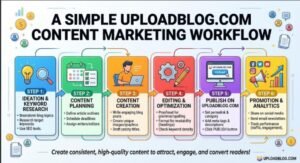
A practical workflow can be surprisingly simple.
Step 1: Research the audience: Identify a real problem, question, or information gap.
Step 2: Check search intent: Determine whether users want information, instructions, comparisons, or a solution.
Step 3: Create an outline: Plan the H2 and H3 structure before writing.
Step 4: Write for humans: Explain the subject clearly and add examples where useful.
Step 5: Optimize for SEO: Add the primary keyword, related terms, descriptive headings, appropriate links, and a useful meta description.
Step 6: Edit carefully: Remove repetition, weak claims, unnecessary filler, and awkward keyword usage.
Step 7: Publish and promote: Share the article through appropriate channels instead of expecting search engines to provide all traffic.
Step 8: Measure and improve: Review performance and update content when information changes or readers need a better answer. This process makes uploadblog.com content marketing part of a repeatable system rather than a collection of disconnected blog posts.
Final Thoughts
UploadBlog.com content marketing can be useful when it is treated as part of a thoughtful publishing strategy rather than a shortcut to instant SEO results. The strongest approach is straightforward: understand your audience, choose topics based on real needs, create original and useful articles, optimize them naturally for search, promote them through appropriate channels, and measure what happens afterward.
A publishing platform can provide a place to distribute your ideas, but the real value comes from the quality of those ideas and how well they serve the reader. If you consistently create content that answers meaningful questions and demonstrates genuine expertise, you give your brand a stronger foundation for long-term visibility, trust, and sustainable digital growth.
FAQs
Q1: What is uploadblog.com content marketing?
Ans: UploadBlog.com content marketing refers to using useful, audience-focused articles published through UploadBlog.com as part of a broader strategy for visibility, trust, engagement, and business growth.
Q2: Is UploadBlog.com content marketing good for SEO?
Ans: It can support a broader SEO and content strategy when the content is original, useful, relevant, well structured, and created for readers. Publishing alone does not guarantee search rankings.
Q3: What type of content should I publish for content marketing?
Ans: Educational guides, how-to tutorials, industry articles, case studies, comparisons, FAQs, and practical problem-solving content are strong starting points.
Q4: How often should I publish content?
Ans: There is no universal publishing frequency. A realistic schedule that allows you to maintain quality is generally better than publishing large amounts of weak or repetitive content.
Q5: Should I use the keyword “uploadblog.com content marketing” repeatedly?
Ans: No. Use the focus keyword naturally and support it with related terms such as content strategy, SEO, audience engagement, organic traffic, and content distribution.
Q6: Can UploadBlog.com content help build brand authority?
Ans: Useful publishing can contribute to authority by demonstrating knowledge and consistently helping a relevant audience. Authority comes from the overall quality and credibility of your work, not from publishing on one platform alone.
Q7: Should I include backlinks in marketing articles?
Ans: Include links when they genuinely help the reader. Avoid adding irrelevant or excessive links solely for SEO purposes, and make sure any claims or references are supported by trustworthy sources.